SAC-Bolivia
Introduction
Minerasac SA S.R.L. – Bolivia or SAC SA S.R.L. (“SAC” or “the Company”), has been restructured as a wholly owned subsidiary of South American Copper Ltd. (BVI) and owns substantial mineral resource assets in Bolivia, South America. With its head offices located in Santa Cruz, Bolivia, SAC is an up and coming mining company that is committed to becoming a significant low cost producer of copper, silver and gold.
The Company is currently concentrating its development and production efforts on four large mineral concessions where they have discovered three new VMS (Volcanogenic Massive Sulfide) deposits containing primarily copper, silver and gold. These concessions are located within the State of Santa Cruz within the northeastern PreCambrian region of Bolivia and cover approximately 420 square kilometers. SAC is already in test production on its Gran Serpiente concession, with a midsized gravity wash plant on their property known as the C-Zone. The test production in this zone started in February of 2014 and continues to produce on a test-mining basis.
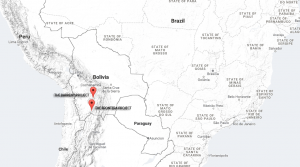
SAC-Bolivia controls one hundred percent (100%) of four (4) concessions covering forty-two thousand one hundred and seventy-five (42,175) hectares in the region of Ascension de Guarayos on the eastern side of Bolivia: Gran Serpiente which covers 292 quadriculars (25-hectare mining squares); Tumbaco covers 731; Pinduca 509; and Cruz de Oro 155. These concessions are located within the northeast end of the Precambrian Shield near Ascension in eastern
Bolivia.
Within Bolivian regulations, a mining concession gives you title and authorization to operate and exploit mines. Depending on the timing and the type of operations, further authorizations may be required. Accordingly, SAC has all the necessary environmental and operating permits to launch their present expansion plans.
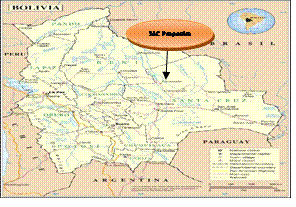
South American Copper’s Concessions and Project Location
The Project
To date, the Company’s project has undergone extensive exploration with over $27,000,000 invested on the exploration and development of the properties. Over 90 geological reports have been produced and written to SEC standards. More than 21,000 samples and assays have been made through 8,400 feet of auger drilling, 11,000 feet of reverse circulation drilling and 27,000 feet of diamond core drilling. More than 8 miles of trenches have been dug and 5,500 trench samples have also been taken and analyzed. The company is currently updating its electronic data room and all reports are available for review upon request.
Proven & Probable Reserves Already Identified
As a result of this exploration, a new VMS deposit has been identified and has been found to contain at least 3 distinct and separate lenses. The three lenses have been further broken down to contain three levels of mineralization. The Oxide Zone, which has a proven reserve of 2,528,000 tons of material at 1.03 to 1.12 gms/ton of gold and total of 4,361,000 proven and probable tons of material with between 0.83 and 1.64 gms/ton (average 1.232 gms/ton) of gold for a total of 172,738 troy ounces of gold (over $220,000,000 value at today’s pricing of about $1,300 per troy ounce).
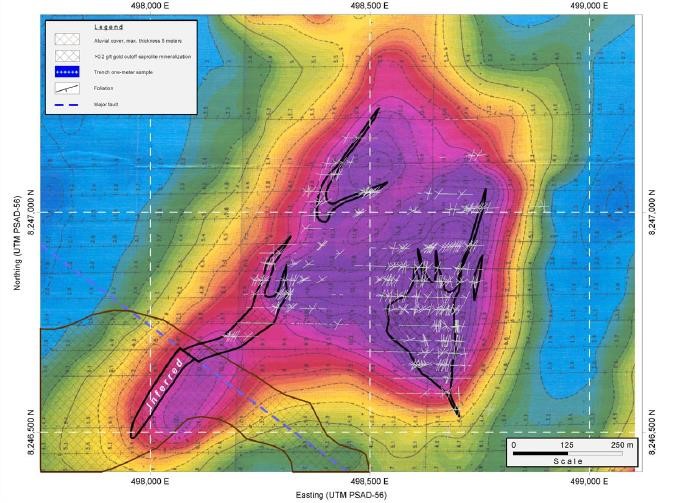
The Company’s Core Assets, A-1, A-2 and A-3 VMS Lenses shown in this Geophysical View of IP Survey Chargeability Contours
The Supergene Zone has 2,162,000 proven tons of material at 1.72% copper with 37,186 tons or 82,000,000 pounds of copper and a total of 6,537,000 tons of material at 1.85% copper which equates to 120,935 tons or 267,000,000 pounds of copper (more than $800 million value at $3.00 per pound of copper). The primary zone lies below the Supergene Zone and is still open in three directions.
No resource has been attributed to the Primary Zone at this time, but the Company believes that the number is substantial. The Company also has a significant silver resource with over 1,000,000 ounces in the A-1 Zone alone. An SEC compliant (Series 7) Technical Report that includes the property’s mineral resource and reserve values has been prepared for the A-Zone property and is available for review.
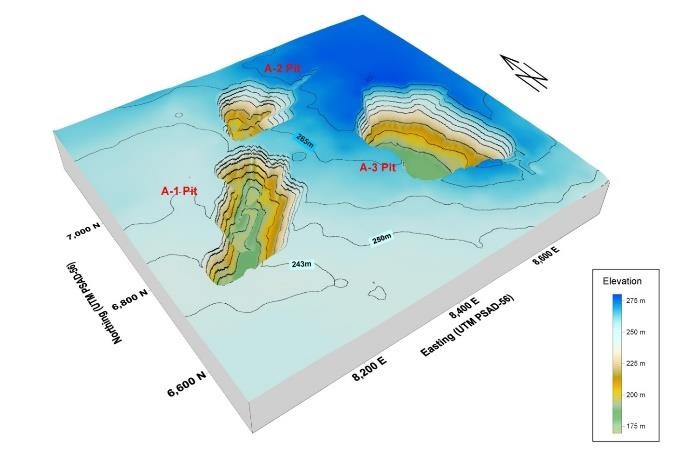
Rendering of SAC’s Open Pit Model for the A-Zone
The Project’s Concessions and Land Holdings
As indicated, the Company owns four separate, but contiguous, substantial mining concessions in the State of Santa Cruz, Bolivia. They encompass 42,175 hectares or just over 420 square kilometers. SAC owns a 100% interest in all of their Santa Cruz concessions, including all of the buildings and equipment. The concessions are easily accessible by paved and gravel roads and are located near the town of Ascension de Guarayos, 310 kilometers north of the main city of Santa Cruz de la Sierra.
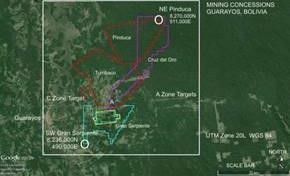
Map of SAC’s Land Holdings four concessions covering more than 420 Square Kilometers
The Company also owns 668 acres of real property where the SAC’s camp facilities are presently located and also where the A-1, A-2 and A-3 Zones are located.
The C-Zone, Gran Serpiente Production
The mining in the C-Zone uses a very simple gravitational process because of the free gold and the free digging material. The company has built a low cost, high efficiency gravity circuit to recover this free gold. The quality of this free gold recovered to date has been refined to be between 94.5 – 97.4% pure. This purity is among the best produced in the country and it is processed on site in the C-Zone. SAC has been in test production since February 2014 and the Company intends to expand this operation in the third or fourth quarter of 2019. The key to this operation is that it will remain low cost, with SAC estimating the cash cost of the production of the gold at less than US$200 per troy ounce due to the free digging nature of the elluvial, colluvial and alluvial material as well as the very low stripping ratio.
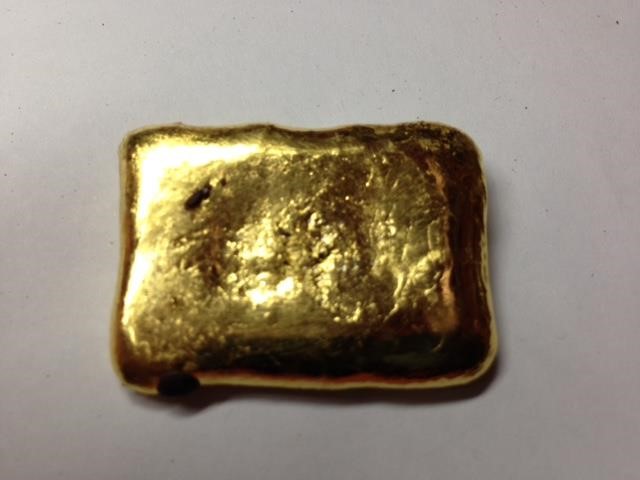
Photos of Gold Dore Processed from the C-Zone is 94.5 – 97.4% pure
The company feels that the C-Zone has significant upside potential because of the new discovery of an ancient paleo channel that runs for over two kilometers. SAC has only test mined about 300 or so meters of this canal so far since its discovery in July of 2014. Expansion of this area is now underway as the Company is now looking beyond the two kilometers and looking for higher ore grades deeper into the channel. The projected revenues in the C-Zone alone, could prove to be more than significant over the next 4 years. The expansion of the C-Zone operations in the third or fourth quarter of 2019 is designed to increase the throughput, the recovery efficiency and the overall productivity of the gravity plant.
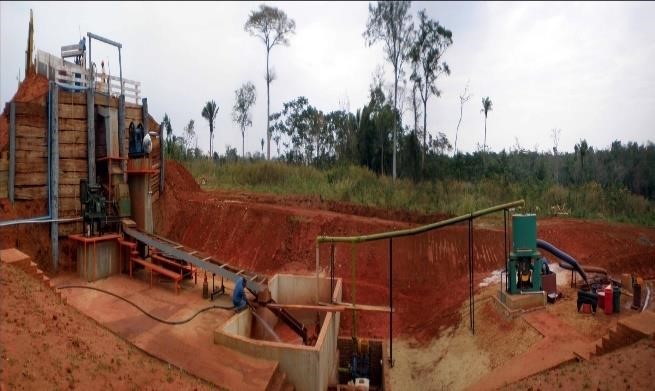
C-Zone Gravitational Plant for test production
Mining Plan Summary
South American Copper Ltd., (the “Company”) has been restructured to make itself more attractive to a potential takeover or partnership with an international mining group. SAC is currently in discussions with four groups who are each considering either a takeover or significant equity interest. SAC is currently making plans to execute Phase 1, 2 and 3 of its four-phase development plan of its VMS deposit located in Eastern Bolivia’s greenstone belt about 300km north of Santa Cruz de la Sierra. The extraction plan has been designed based on the data created by Essex Resources and now owned by the Company. The Phase 1 plan of operation is a well-defined short term project that can also be presented as a separately funded business plan and is available upon request. The work area will be cleared and a washing facility established during an initial “zero month” after startup. The actual excavation and washing operation is planned to require a three to four- month timeframe after initial startup. While the company is executing its Phase 1 extraction plan it will be initiating the necessary steps to move to Phase 2 and 3 within 8 to 9 months from startup. This includes a drill program designed to increase the Company’s reserves and finalize the extraction plan for the Supergene and Primary copper zones. Startup will require the funding to be in place and fully accessible for field operations. The budgeted requirement is US$10,000,000 to execute the Phase 1-3 plans. The Phase 1 plan provides details for the capture and sale of 7,210 ounces of gold over an operational period of eight to nine months from startup. The Company feels that this number is conservative as it estimates only a 30% recovery of the material washed. It is anticipated that this business unit should obtain a production value of at least $9,000,000 in gold (at $1,300/oz) in just eight to nine months from funding. Phase 1 and Phase 2 are designed to exploit the gold and silver in the first 40 meters of depth in the VMS lenses. The Phase 1 is a simple washing of the gold from high-grade cores of the lenses as these grades may not be recovered by a heap leaching facility. The program requires the clearing of the working areas around the initial target zone and the construction of a washing facility. This is a temporary plant including a grizzly, screening process, 2 sluice boxes and 2 centrifugal concentrators. An additional requirement is a tailings impoundment to hold the tails for further processing, either by an in-place vat leaching system (should one be required at this point) or later placement on to the heap leaching facility. This Phase is estimated to generate approximately US$9,000,000 in revenue. There is also an oxide copper resource indicated in the Oxide Zone that contains 1.6 million pounds of copper at 0.12% copper that is potentially associated with jarosite and will have to be stockpiled while further research and testing of the metallurgy for recovery of the copper is conducted.
Phase 2 is designed to start the heap leaching facilities and process. This requires the construction of the liner for the pad, plumbing for spraying the CN fluids, collection ponds, piping for the electro-winning recovery system, etc. This operation may require a crushing circuit, a trommel or screening facility, and laboratory and refining facilities. The US$10,000,000 is planned to begin the heap leaching process that has a historical resource estimated at 172,000 ounces of gold (Biste, 2011). It is anticipated that the revenue generated by the Phase 1 and beginning of the leaching process will generate sufficient cash to maintain the Program leading into the third phase, the exploitation of the Supergene chalcocite copper resource.
Phase 3 of the program is to exploit the copper mineralization. The Supergene extended resource has 267,000,000 pounds of copper at 1.85% in 6.5 million tons of mineralized rock also containing gold and silver credits. An outside private company has estimated that the A1 Lens Supergene resource alone contains 75 million pounds of copper at 3.13% copper, 17,000 ounces of gold at 0.49 g/t and 287,000 ounces of silver at a grade of 8.19 g/t. Evaluation of the metallurgical recovery processes for each of the three zones of the VMS will be instituted at the time of funding and will continue through all the early Phases of work.
During Phase 1 we will select a non-mineralized area to clear and layout the heap leach pad and facilities. The gold resource of the gossan zone consists of approximately 172,800 ounces (4,361,000 tons at 1.232 g/t taken from Biste, et al. 2004, 2011, 2016) and this is the target for production in Phase 2. We will verify and modify the operations as we obtain more detailed information on the mineral processing. We have a reasonable amount of previous work that will expedite our investigations and we plan to develop our own construction planning on site along with the various testing facilities (Assay, Metallurgical, and Geo-Tech) in the initial phase of work. The company envisions a 2:1 stripping ratio using a 60-degree hanging wall slope and following the 45-degree footwall angle. We will also develop a location for waste rock storage. To begin our mining phase, we will require locations for top soil storage, waste rock storage and areas for the facilities. Phase two is anticipated to generate income starting in the 3rd quarter after funding. The company estimates revenues of about $3,250,000 in the 3rd quarter, $5,785,000 in the 4th quarter and then $21,260,000 for each of the next 5 quarters in only gold production.
SUPERGENE COPPER ZONE (Phase 3)
Continued mining will expose and then exploit the highergrade copper in the Supergene Zone approximately 45m thick directly under the Oxide Zone. This material is estimated to contain 267 million pounds of copper in 6,537,000 tons at 1.85% copper, with limited gold values but global silver values in the A-1 Lens averages 8.1 g/t (525,000 ounces of silver in the A-1 Lens supergene zone alone). More metallurgical testing is required to optimize the copper recovery process but is now thought to be addressed by flotation methods using any of the newer reagents such as those by “CyTex” or “Oceans Technologies” which produce very good results including an ability to scrub any antimony (limited values in our system). The flotation system will require a tailings impoundment area which can be located and developed while mining the gold zone in Phase 2 (the advantage of heap leaching the oxide materials is that we can retain the permanent heaps and not require a tailings location earlier in our exploitation).
The extraction of both the Supergene copper and the Oxide gold will better expose the Primary Sulfide mineralization for bulk sampling for full scale metallurgical testing to optimize a recovery process and assist in defining the full characteristics of the principal target. It will allow for better controls on infill drilling programs, rock classification for mine planning and induce an extremely high level of confidence in the initial potentials of these primary 3 VMS Lenses. All this data will assist in the further and ongoing evaluation of the potential of the favorable stratigraphic horizon that hosts these VMS deposits along the entire Greenstone Belt on the 35km of favorable geology in the concessions’ ground.
Limited testing of the Supergene Zone has been completed in the past and those reports are in our data room. This fullscale phase of exploitation will be addressed immediately when we obtain metallurgical support on site during our first phases. The economics can be generated by the above resource target values. As before, all mineralization is open in all directions and we anticipate being able to rapidly expand the mineralization by our early drilling program in the preliminary phases. Phase three is anticipated to generate copper sales and income starting in the 6th to 8th quarter after funding. The company estimates copper sales revenues of about $9,775,000 in each of the first 2 quarters after the production of copper starts and then $37,692,000 in each of the next 15 quarters in copper production alone.
PRIMARY SULFIDE ZONE (Future Phase 4)
The Primary Sulfide Zone of the VMS has only undergone limited testing to date. The potential is completely unknown as all three lenses are open in all directions. It is planned to continue to explore and test the Primary Zone as exploitation activities continue on the upper two zones of the VMS Deposits. The “Blue Sky” potential is staggering. The raw data has been organized into an electronic data room and we are now reformatting it into viable working and planning maps and sections. The drill hole and trench data is available in digital format and will have to be organized and evaluated with appropriate software (now being reviewed).
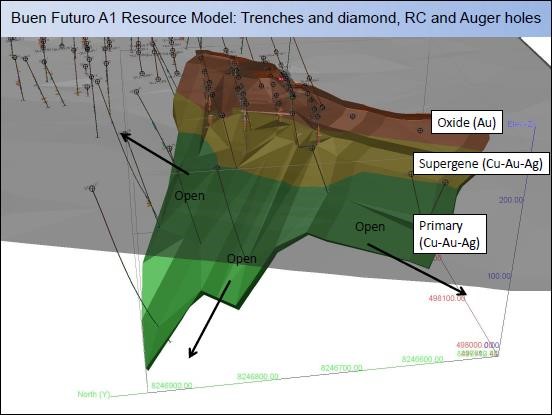
Computer Model of the A-1 Zone showing that it is open in all three directions.
The currently available potential of the Primary Sulfide Zone is highly restricted as extremely little drilling has been done into this zone. The numbers that have been written vary but one outside review group modeled the A-1 lens only, too limited data was available for a minimum population. This review suggested a global resource of 2 million tons at 0.84 g/t gold (54,000 ounces), copper at 1.41% providing 62.5 million pounds of copper and a silver grade of 8.1 g/t for 525,000 ounces.
Upside Potential
Although the company already has a seven-year plan to fully exploit the first three lenses, one must remember that each of the three defined lenses are still open (larger and not fully defined) in three directions. This will add a significant boost to the company’s reserves. In addition, the company will further define 8 other already identified copper anomalies, which may be additional lenses and exponentially increase the company’s reserves. Like in other worldwide VMS deposits, VMS lenses tend to develop in clusters with an average of 10-15 lenses per deposit. Chris Cherrywell, the Company’s QP, believes that SAC may have an 80-100-year extraction project.
Project Map